Computational Immunotherapy • Eigen Sciences • 01/2024 – 06/2025
Overview
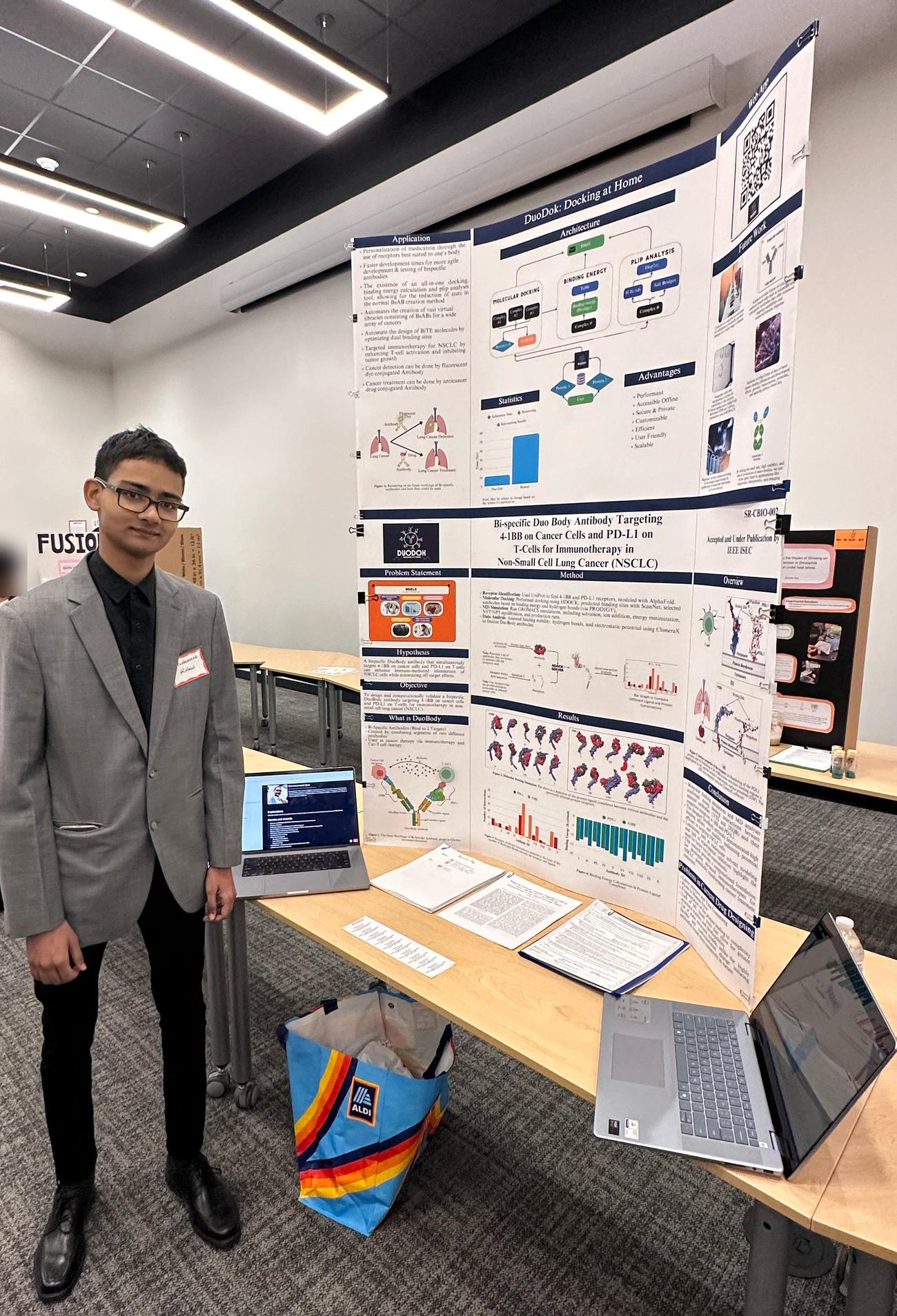
First-author computational study, conducted with Gaurav Sharma of Eigen Sciences, that designs and evaluates a bispecific DuoBody antibody engaging 4-1BB on cancer cells and PD-L1 on T-cells as a potential immunotherapy for non-small cell lung cancer (NSCLC). The work is accompanied by DuoDok, an independent web tool that automates parts of the workflow.
Research question
Can a single bispecific antibody simultaneously engage PD-L1 and 4-1BB with high affinity and stability, and can the computational workflow that evaluates it be automated?
Motivation
Non-small cell lung cancer is a leading cause of cancer deaths, and dual-target antibodies may strengthen the immune response beyond single-target checkpoint inhibitors. Computational design lets candidate antibodies be screened quickly before costly laboratory work.
Computational pipeline
Protein selection
10 antibodies and 2 receptors (4-1BB, PD-L1)
Structure modeling
AlphaFold
Binding-site identification
Locate where each antibody engages its receptor
Molecular docking
HDock
Interaction analysis
PLIP and Prodigy
Molecular dynamics
GROMACS simulation of stability
Methodology
Ten antibodies and two receptors were evaluated through a six-stage pipeline: protein selection, structure modeling (AlphaFold), binding-site identification, molecular docking (HDock), interaction analysis (PLIP, Prodigy), and molecular dynamics simulation (GROMACS). DuoDok automates portions of this workflow as a web application.
Outcomes
Docking and molecular dynamics confirmed an optimal bispecific antibody design for 4-1BB and PD-L1. The selected design showed high predicted affinity and stability, supporting it as a promising NSCLC-targeting candidate. Published at IEEE ISEC 2025 and recognized with the Outstanding Poster Presentation Award (ACS NERD 2025) and the Medal of High Honors (Terra Science Fair).